Advertisement

Heuer Dialog's "Quo Vadis 2026 - 36. Jahresauftakt für Immobilienentscheider"- conference opened with a message that was less about property cycles than about power structures. Europe, speakers argued, is under simultaneous strategic pressure from both directions: an increasingly unpredictable United States and a disciplined China pursuing long-term technological supremacy. For the German real estate industry gathered at Berlin’s Hotel Adlon, this was not abstract geopolitics. These forces shape capital flows, industrial location decisions and, ultimately, the fiscal capacity of the German state.
Cathryn Clüver Ashbrook, German-American political scientist and senior adviser to the Bertelsmann Foundation, framed the United States not as collapsing, but as entering a phase of structural unpredictability. For Europe, the issue is less partisan politics than reliability. The transatlantic framework that has underpinned European security since 1949 can no longer be treated as immutable.
The Trump administration, she argued, reflects a deeper shift within American conservatism toward executive concentration of power and a more transactional foreign policy. Checks and balances remain formally intact, but institutional tensions have increased markedly. The possibility of political friction surrounding future elections adds further uncertainty. For European policymakers and investors alike, the question is not whether American democracy survives, but whether American policy remains stable and alliance-oriented.
This matters economically. Under pressure, the US is more likely to pursue tariff measures, industrial subsidies and deal-based diplomacy. Such an approach reshapes trade flows, regulatory alignment and capital allocation. It also complicates long-term planning for European export industries and cross-border investment strategies.
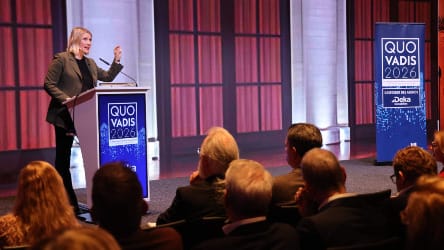
Ashbrook suggested that Europe must avoid purely reactive positioning. A more transactional Washington creates risks, but also openings. Investors, she noted, may find opportunity in periods of US weakness. Yet the broader implication is clear: Europe can no longer assume that American security guarantees and economic coordination will function as they did in the post-Cold War era.
For Germany, that shift has fiscal consequences. If US commitments become conditional, Europe will be required to carry a larger share of its own defence and industrial burden. That burden ultimately passes through public balance sheets and capital markets.
If the United States represents volatility, China represents strategic continuity. Felix Lee, business journalist at Süddeutsche Zeitung and long-time China correspondent, argued that Europe has consistently underestimated the coherence of Beijing’s industrial policy.
China’s ambitions — from the New Silk Road to technological self-sufficiency — were never concealed. The West simply did not treat them as binding strategy. Of the 20 technology fields targeted for dominance by 2025, Lee noted, China has made decisive advances in the vast majority, including robotics, high-speed rail, solar technology, battery storage and drone systems. These are not marginal sectors; they sit at the core of infrastructure and energy transformation.

If China succeeds in closing the remaining gap in semiconductor capability, it moves close to full technological autonomy. The longer-term objective, articulated repeatedly in official planning documents, is to make global supply chains structurally dependent on Chinese standards and components by 2049.
The consequence is the gradual division of the global economy into competing techno-industrial blocs. Alignment with one system increasingly limits access to the other. Building parallel supply chains is possible — but costly. “In any case, it will be more expensive for all of us,” Lee observed.
For Europe, the implications are structural. The globalisation model that sustained German export growth is fragmenting. Industrial competition has intensified. Market share in key sectors is eroding. Without coordinated industrial and technological policy, Europe risks marginalisation in precisely those industries that underpin its prosperity.
The strategic response, Lee argued, must include technological sovereignty in selected sectors, a realistic assessment of China as a systemic competitor and deeper engagement with the Global South. Europe’s advantage remains its rules-based system and regulatory credibility — but only if these are combined with strategic coherence.
Taken together, the two keynotes described a Europe caught between volatility and calculation. One power is becoming more transactional and politically unpredictable; the other is methodically consolidating industrial leverage. Both developments carry economic consequences.
For Germany, this is not an external debate. Strategic autonomy requires financing. Industrial sovereignty requires subsidies, infrastructure and public investment. Greater security responsibility implies structurally higher defence expenditure. None of this is cost-free.
The comfortable assumptions of the post-Cold War era — open markets, stable alliances, predictable capital flows — are fading. The question now is not whether Europe must adapt, but how quickly it can translate geopolitical pressure into fiscal and industrial capacity. That transition will shape not only Europe’s security posture, but its bond markets, industrial geography and, ultimately, real estate investment allocations.
The pressures described by Ashbrook and Lee would be manageable if Europe could respond with strategic coherence. In a thought-provoking final conference address, Dr. Sönke Neitzel, Professor of Military and Cultural History at the University of Potsdam, suggested it cannot.
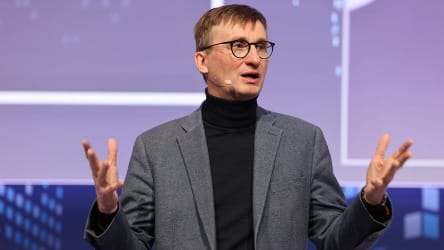
He did not question Europe's wealth or industrial base. On paper, the continent has the engineering capacity, the technological know-how and the financial resources to defend itself. The deficit, he argued, is strategic rather than material. Europe struggles to translate resources into capability.
His central scenario was deliberately modest. Not Russian tanks advancing westwards. Not a march on Berlin. Instead, a rapid move into Narva in Estonia, or a limited seizure of territory in Lithuania — a fait accompli designed not to conquer Europe, but to test it. Would NATO respond militarily? Or would hesitation creep in?
The danger, Neitzel suggested, lies less in territorial loss than in credibility. If the alliance falters, deterrence erodes. At that point Europe faces a stark choice: accept a reduced strategic role or expand its own military capability far more decisively than it has so far contemplated. Neither path is cheap. Accommodation would weaken the rules-based order that underpins European trade and investment, while rearmament demands sustained fiscal commitment and political consensus at home.
Germany's internal constraints complicate that adjustment. The Bundestag no longer commands the two-thirds majority required to declare a formal state of tension, the constitutional bridge between peace and war that grants expanded Bundeswehr authority and emergency powers. Parliamentary fragmentation makes decisive moves harder. Structures designed for stability are not optimised for speed.
Neitzel was particularly critical of how Europe spends what it does allocate. Defence policy, he argued, often functions as industrial subsidy. Regional politics intrude. Offset agreements inflate costs. The long development of the Franco-German Tiger helicopter became his case study: conceived in the 1970s, delivered decades later, produced in incompatible variants and now being phased out. Europe built hardware; it did not build coherence.
The same logic runs through procurement more broadly. If Norway buys German equipment, political pressure ensures reciprocal purchases regardless of efficiency. Interoperability suffers. Capability is delayed. What Europe lacks is not factories but a genuinely integrated defence market — political decisions about who produces what, based on strategic need rather than electoral geography. "When I'm in Berlin," he remarked dryly, "I don't see any sign of that plan."
The most uncomfortable part of Neitzel's talk concerned nuclear deterrence. French and British arsenals exist, but they are sovereign instruments. France's force de frappe is designed to defend France. Would Paris defend Estonia with nuclear weapons? Unlikely. Nuclear autonomy is central to French sovereignty. Tactical sharing is politically and legally complex. Germany, bound by treaty, cannot develop its own capability. The result is strategic ambiguity: either renewed American guarantees anchor deterrence, or Europe must compensate conventionally — and expensively — through larger standing forces of its own.
That cost is not hypothetical. Defence spending of 3.5% of GDP, a figure circulating in political debate, would represent a structural change if sustained. Industrial sovereignty — reducing dependence on Chinese supply chains — requires long investment cycles. These priorities sit alongside demographic ageing, energy transition and infrastructure renewal. Germany's constitutional debt brake limits federal borrowing to 0.35% of GDP in normal times, constraining fiscal space. Higher security spending therefore implies trade-offs: reallocation within budgets, tax adjustments or revisions to fiscal rules.
Bond markets will not ignore such shifts. Sustained higher issuance to fund defence and industrial policy affects yields and financing conditions across the economy. Real estate is not insulated from sovereign fiscal choices.
Neitzel's broader point was less about equipment than about mindset. Europe is not incapable; it is slow. Administrative layers and regulatory conflicts absorb time, and decisions are deferred rather than prioritised. Past periods of adjustment were driven by leaders willing to impose concentrated costs for strategic clarity. Whether today's political class will do the same remains open.
By the time Neitzel finished, the thread connecting all three keynotes had become clear. America offers unreliable partnership. China executes long-term industrial strategy. Europe possesses resources but lacks strategic planning. The question is no longer whether Europe faces a harder security environment, but whether its political systems can respond at the pace that environment now demands.
For Germany, that is not an abstract debate. Security spending is shifting from exception to baseline. Fiscal priorities are hardening and bond markets are adjusting. Resources exist; plans, Neitzel implied, do not — at least not yet.
The real test is not scale but speed. How quickly Germany converts strategic awareness into durable capability will shape not only Europe’s security posture, but the stability of the investment environment in which long-term capital — including real estate — operates.
Get access to selected articles


