Advertisement

Richard van de Beek is Head of Asset Management at the ROSA-ALSCHER Group, a Munich-based developer and investor active across residential, office and mixed-use projects.
Large urban quarters are often evaluated through the lens of urban planning. Density, mobility infrastructure, architectural coherence and tenant mix usually form the checklist. The implicit assumption is that urbanity can be delivered through design – and an intelligent mixed-use space concept is very important in this regard. However, the more pertinent question arises once construction is complete.
A neighbourhood does not emerge at the point of handover. It does not take shape on opening day or once it is fully occupied. It is formed gradually, through routine: through the way people begin to move through space, adopt certain routes, establish habits, and integrate places into their daily life. Urban theory has long pointed out that city districts depend less on formal structure than on everyday interaction. Jane Jacobs, the author of the monumental and thought-provoking book The Death and Life of Great American Cities famously described urban vitality as something being generated by repeated, ordinary presence. She referred to this as the “sidewalk ballet” of daily coexistence, rather than as abstract zoning logic.
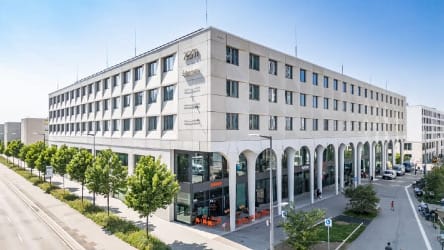
This is also where the limits of planning become visible. Mixed-use concepts promise synergy, but synergy is not an automatic outcome of adjacency.
Short distances and functional diversity only provide a framework. Whether or not retail, gastronomy, workspaces and public areas actually reinforce each other depends on the use patterns that develop over time.
The “15-minute city”, promoted by Carlos Moreno, has sharpened this focus on proximity and access. Its premise is clear: cities should allow daily functions to be reached within short walking or cycling distances. But proximity alone does not generate neighbourhood life. The decisive factor is whether people actually live locally, build routines locally, and see the district as part of their everyday geography. Recent research on “living locally” confirms this distinction. It shows that neighbourhood attachment grows through walking routines and everyday activities, rather than through design intentions.
This is where the discussion becomes increasingly economic. For investors, developers and operators, the success of a quarter is no longer defined only by construction quality or leasing performance. It is defined by resilience: the ability of the district to sustain footfall, relevance and value beyond the initial launch phase. Retail market dynamics illustrate this clearly. In many European cities, high streets and shopping centres face structural pressure from e-commerce, polarised consumer demand and changing mobility patterns. Mixed-use quarters are often positioned as an answer, but they only function if the environment continuously attracts people for reasons beyond consumption.
In this sense, neighbourhoods are more than just assets. They are operating systems. This introduces a dimension that is still underestimated in many development models: the management and activation of neighbourhoods after they have been built. Academic work on public space and urban management notes that while enormous resources are spent on maintaining and operating urban environments, strategic and integrated management remains insufficiently developed in practice.
The market is increasingly recognising why this matters. A quarter may open with a strong tenant mix, but without stewardship the uses can remain fragmented. Retail may not connect with office rhythms, gastronomy may peak only at weekends, public spaces may feel transitional rather than anchoring.
In such cases, the planned “urbanity premium” does not materialise. Placemaking research has therefore shifted attention from design to activation. Successful districts are not produced solely through architecture, but through activity, encounter and social attachment. Public space becomes truly urban only when it supports repeated use, inclusion and a sense of belonging.
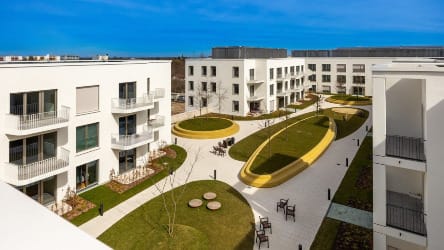
This has direct implications for real estate markets. If neighbourhood life produces stability, then operational capacity becomes a value driver. Footfall is not just a retail metric, but also an indicator of urban integration. Programming is not just marketing, but also part of place governance. District management is not an optional extra, but a mechanism for long-term performance.
This is why quarters cannot be treated as finished products. They require active and centralized stewardship after opening, not only infrastructure before opening. They require tools that help residents and visitors expand routines, discover overlooked spaces, and gradually produce the “ordinary urbanity” that cannot be planned on paper. Furthermore, they require communication, online and offline, to help people discover new areas of the quarter or strengthen their identification with the area.
The future of any new district is therefore determined less by its masterplan than by its users. The decisive question is not whether the buildings are finished. Rather, it is whether the quarter becomes a place that people return to, recognise themselves in and slowly make their own in everyday life.
The ROSA-ALCHER group are the builders of the new district centre in Munich-Freiham - the ZAM, one of the largest neighbourhood developments in Europe. Just north of the Bodenseestrasse, the complex will have 10,500 residential unit and accommodate 15,000 workplaces. Find out more: zam-muenchen.de
Get access to selected articles


