Advertisement

While much of German retail property spent 2025 debating reinvention, from mixed-use strategies to vacancy management and the future of the high street, food-anchored retail quietly delivered record investment activity. Retail park transaction volume rose 53% to €3.1bn. Investment in supermarkets and discounters climbed 32% to €1.1bn, roughly one sixth of total retail volume. Occupancy across specialist food retail portfolios remains at 98–99%, while the underlying sector has now exceeded €200bn in annual turnover for the second consecutive year.
These are not the metrics of a sector in distress. They are the indicators of a segment operating according to a different set of rules.
The explanation is structural. Food retail is non-discretionary, frequency-driven and embedded in daily life. Consumers visit supermarkets and discounters one to three times per week regardless of sentiment or macroeconomic conditions. Online competition remains limited. Even by 2030, e-commerce is expected to account for less than 9% of total food retail turnover. At the same time, the market is dominated by four large, creditworthy operators, Edeka, Rewe, the Schwarz Group and Aldi, which together account for around three quarters of total sales and continue to invest and expand.
That stability carries through into the real estate. Lease terms of 15 years are standard, turnover-linked rents are rare, and once a location is established, renewal is the norm. Failures tend to reflect local misjudgements, such as catchment or competition, rather than wider economic cycles. As Fabian Schultheis of investment manager Dr. Peters notes, retailers prefer to rent rather than own in order to preserve capital flexibility and focus on operations. For landlords, this results in long-duration, operationally critical tenancies with strong incentives to maintain performance.
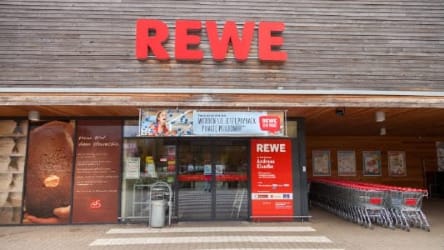
The investment case has emerged from the recent market correction intact, but more disciplined. At the peak in 2021, prime food retail assets traded at 25–26 times annual rent. Today, new discounters typically transact at 16–18 times. As Habona Invest’s Guido Küther observes, “investors have learnt where prices can go.” Pricing has reset, but demand has not.
What has changed more fundamentally is how the sector is viewed. Food-anchored retail is no longer assessed against shopping centres or high street assets. It is increasingly compared with residential property or fixed-income instruments, reflecting its income stability and defensive characteristics. As supermarket fund manager Habona’s Carsten König puts it: “Local retail stands on its own.”
The scale of the opportunity reinforces that positioning. Around 28,000 food retail properties in Germany are considered investable. Transaction volumes remain robust, with specialist retail accounting for nearly half of total retail investment activity. At the same time, there is still scope for active value creation. Analysis by BNP Paribas Real Estate suggests a structural shortfall in store size, with supermarkets on average around 450 sq m below optimal levels and discounters around 250 sq m short. Addressing that gap, through extensions or redevelopment, can unlock higher rents and new long-term leases. Much of the sector’s upside lies in incremental operational improvement rather than yield compression.
If the asset class has become mainstream, differentiation increasingly lies at the level of execution. Tenant quality, micro-location and competitive positioning matter, particularly given the intensity of competition between the dominant operators.
The 2025 price war, triggered by Lidl’s aggressive discounting campaign, illustrated the pressure on margins without materially shifting market share. Growth across the major groups has converged, reflecting both market maturity and saturation. More important is the strategic divergence emerging beneath the surface. Lidl and the Schwarz Group are investing heavily in digital integration and customer ecosystems, while Aldi continues to balance its traditional cost-leadership model with the need for modernisation. Performance differences are already visible. Aldi Nord grew significantly faster than Aldi Süd in 2025, highlighting how execution at operator level feeds through into store performance.
For investors, this translates into a familiar but essential point. Not all grocery assets are equal. A modern Lidl or Aldi store in a strong catchment with limited direct competition offers a fundamentally different risk profile from a secondary location in a saturated market. The asset class may be resilient, but individual assets still require granular underwriting.
The same applies to the physical product. Construction standards and ESG requirements are evolving, but not yet uniformly. While operators and developers are experimenting with more sustainable formats, including timber construction and improved energy efficiency, these factors remain secondary to location, tenant strength and catchment fundamentals in determining value.
The broader conclusion is that food-anchored retail has moved out of the shadow of the wider retail sector and established itself as a distinct investment category, defined by necessity-driven demand and long-term income stability.
Investors should note that this does not make the segment immune to pressure. Competition between operators is intensifying, formats are evolving, and location quality remains decisive. What has changed is not the need for discipline, but the nature of the risk. In this part of the market, performance is less about consumer sentiment and more about execution: who the tenant is, where the asset sits, and whether it continues to meet the operational requirements of a highly concentrated and increasingly sophisticated occupier base.
Get access to selected articles


