Advertisement

Southern Germany's office investment markets offered a useful reality check in 2025. Frankfurt, Stuttgart and Munich all remain firmly in the “core” category for institutional investors. Yet last year showed just how differently core markets can behave once cheap money has gone and price discovery takes centre stage. Volumes alone tell only part of the story. Behaviour tells the rest. (See our adjacent story on Cologne and Düsseldorf in this issue of REFIRE.)
Frankfurt entered 2025 with expectations already dialled down. Even so, the year proved bruising. Transaction volumes collapsed across most broker datasets, large-ticket deals were conspicuously absent, and the fourth quarter failed to deliver the long-hoped-for inflection point. Estimates ranged from €518m (Colliers) to €1.35bn (JLL), depending on definition, but even the upper figure still represented a decline of more than 80% from the ten-year average. The €187m sale of the SAP Tower in Eschborn stood out less for its size than for its rarity.
The collapse was stark precisely because product was available. Leasing activity was robust by recent standards, vacancy high but manageable, and investor interest never fully disappeared. What did disappear was the ability to close large office transactions. Deal counts fell sharply, and where activity did occur it clustered below the scale needed to move the needle.
Frankfurt is also the only one of the three cities where market participants speak almost unanimously of a crowded deal pipeline. Multiple large office assets are already positioned and in advanced sales processes. Processes are slow, financing remains selective and bid-ask spreads stubborn, but the market is not dormant. Properties including the Opernturm, Westend Duo and Welle are in play. In 2025, Frankfurt did not clear. It queued.
Stuttgart lacks Frankfurt’s scale and Munich’s international glamour, but its office investment market told a quietly instructive story last year. Volumes landed between €360m and €415m, down roughly 20% year-on-year. Even so, transactions still cleared where pricing was realistic and assets were well located.
Activity focused almost exclusively on inner-city offices and mixed-use properties, where vacancy remains exceptionally low by German standards at under 4%. These assets were repeatedly oversubscribed. Peripheral locations, by contrast, attracted little interest, while project development continued to be constrained by high costs and regulatory friction.
The buyer base was telling. Private investors and family offices dominated on both sides of transactions, accounting for nearly half of investment volume. Institutional capital remained cautious but not absent. The €55m sale of the Karlsoffice building at Reinsburgstraße to a family office typified the market: well located, sensibly priced and swiftly absorbed.
Stuttgart’s story is simpler than Frankfurt’s or Munich’s, but that simplicity carries its own message. This is a market that has found a form of post-boom equilibrium: fewer deals, smaller tickets, and a system that still clears when expectations are aligned. It was not a recovery story, but nor was it a breakdown.
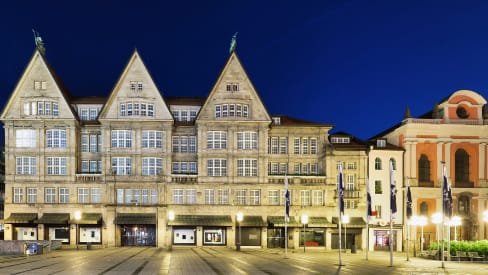
Munich delivered the strongest headline numbers of the three at roughly €2.5bn in commercial real estate. Yet the figures were also the most misleading. A powerful year-end sprint rescued annual volumes, driven by a cluster of very large city-centre transactions totalling around €1.3bn in the final quarter. Strip those out, and the first half delivered barely €980m.
Much of the activity revolved around private capital. One investor alone accounted for more than €600m of acquisitions, roughly a quarter of the entire market. High-profile purchases included the €380m Oberpollinger luxury department store, the Hirmer flagship property and the Sporthaus Schuster. Institutional buyers, by contrast, remained largely on the sidelines, focusing narrowly on core assets and showing little appetite for anything that required imagination or patience.
The geography of activity was equally narrow. Almost 60% of transaction volume was concentrated in the inner city, underlining how selective the recovery remains. Smaller and mid-sized deals provided much of the market’s momentum, while value-add investors quietly scoured prime locations for underinvested office stock. Foreign capital began to reappear, accounting for 46% of investment volume, and banks showed greater willingness to accept write-downs in distressed sales. Price discovery, however, remains incomplete outside the very top tier.
Taken together, the three cities illustrate where Germany’s office investment market actually stands. Frankfurt looks weakest on paper, yet arguably best positioned for a rebound once its swollen pipeline begins to clear. Stuttgart remains narrow but functional, a market where disciplined pricing still produces deals. Munich trades, but selectively and privately, with breadth still missing.
2025 was not the year the office cycle turned in southern Germany. It was the year the rules hardened. Liquidity is there, but it is choosy. Capital is active, but disciplined. And recovery, where it comes, will be uneven, negotiated asset by asset rather than declared in the aggregate.
Get access to selected articles


