Advertisement

Sirius Real Estate has completed an oversubscribed £77m equity raise to fund two German acquisitions weighted towards defence-related tenants, signalling that capital markets are prepared to back targeted German industrial exposure even as the wider property cycle remains selective.
The LSE and JSE-listed multi-let operator issued 75.5m new shares at 102p, a 1% premium to the previous close and in line with NAV, implying roughly 5% dilution. Chief executive Andrew Coombs and fellow directors subscribed for £100,000 in aggregate. The proceeds will fund two pending German acquisitions totalling around €130m, with completion expected in Q2 2026.
The raise follows Sirius’s mid-2025 announcement that it would position for increased German defence and infrastructure spending under Berlin’s expanded fiscal framework. The latest transactions make that exposure concrete at tenant level.
The strategy is already visible in the October 2025 acquisition of a business park in Feldkirchen near Munich for €43.7m. The asset is anchored by Excelitas, a manufacturer of optical and photonic systems for defence, aerospace and industrial applications, which occupies 72% of the park on a lease with 10.2 years remaining. The purchase reflected a 7.8% EPRA net initial yield.
A further acquisition in Hamburg’s Rothenburgsort industrial area for €31.9m generated a 6.1% yield. Across 2025, Sirius deployed approximately €340m into income-producing assets in Germany and the UK.
The geographic pattern is deliberate. New German acquisitions cluster close to existing holdings, reducing integration risk and lowering marginal management cost. Feldkirchen sits minutes from the group’s Grasbrunn park; the Hamburg asset is within half an hour of another Sirius property. The model prioritises density and control over rapid geographic expansion.
Coombs has indicated that from 2026 onwards the primary investment focus will be Germany. The equity raise accelerates that shift.

Alongside its defence-tilted industrial push, Sirius is building out self-storage capacity within selected business parks. In February 2025, the company appointed Tom Lampard from Shurgard as property director for self-storage, with initial facilities planned in Berlin and incremental conversions of existing space elsewhere.
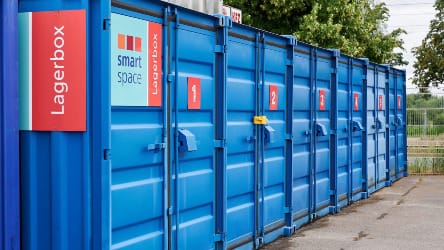
Germany remains structurally under-supplied. Savills estimates provision at 0.27 square feet per capita in 2024, compared with 0.94 in the UK. Rising housing costs and smaller household footprints are supporting demand for external storage, while recent senior financings for platforms such as Lagerbox and 1Box point to increasing institutionalisation of the segment.
For Sirius, self-storage does not require large-scale development risk. The multi-let estate, comprising 145 assets and more than 10,000 tenants with a portfolio value exceeding €2.7bn, offers internal conversion potential where demand, access and layout align. It is a margin-enhancement tool rather than a standalone growth thesis.
The capital raise was multiple-times oversubscribed and priced at NAV, a notable outcome in a market where equity issuance has often required discounts. Shares rose 4% on announcement and are up roughly 35% over the past twelve months. Sirius has also lifted its medium-term funds from operations target to €175m and retains additional capacity through its 35% stake in the €350m Titanium joint venture with AXA IM Alts.
Richard Williams of QuotedData argued that appetite persists for operators with clearly defined positioning, particularly those aligned with German industrial demand linked to defence spending.
The broader question is whether defence-led manufacturing expansion translates into sustained occupier demand across regional business parks. Sirius is positioning early, using balance sheet equity rather than waiting for distressed entry points. If Berlin’s fiscal expansion proves durable, the clustering model could amplify returns. If defence demand underwhelms, the company will need to fall back on its traditional value-add discipline to justify the shift.
For the German market, the immediate signal lies in the equity itself. Capital is not indiscriminately returning to real estate. It is backing operators with operational density, sector clarity and assets aligned with state spending priorities. Sirius has chosen its lane. The market, for now, has agreed.
Get access to selected articles


